
There are currently 49 volcanoes that are erupting, 3 of which are in Antarctica. During the last week, the summit area of Mauna Loa was closed off due to elevated seismic activity. Meanwhile in the Philippines, the Taal volcano produced a small phreatic eruption. And, also in the Philippines, the Bulusan volcano has an elevated risk of producing another eruption in the short term due to a swarm of earthquakes the volcano just produced. This video will discuss these volcano related news stories, as told and analyzed by a volcanologist.
I would like to give a special thanks to A. Eschenbacher for sending me a group of Erebus crystals and volcanic rocks from Mount Erebus, in addition to allowing me to use several photos he took while there!
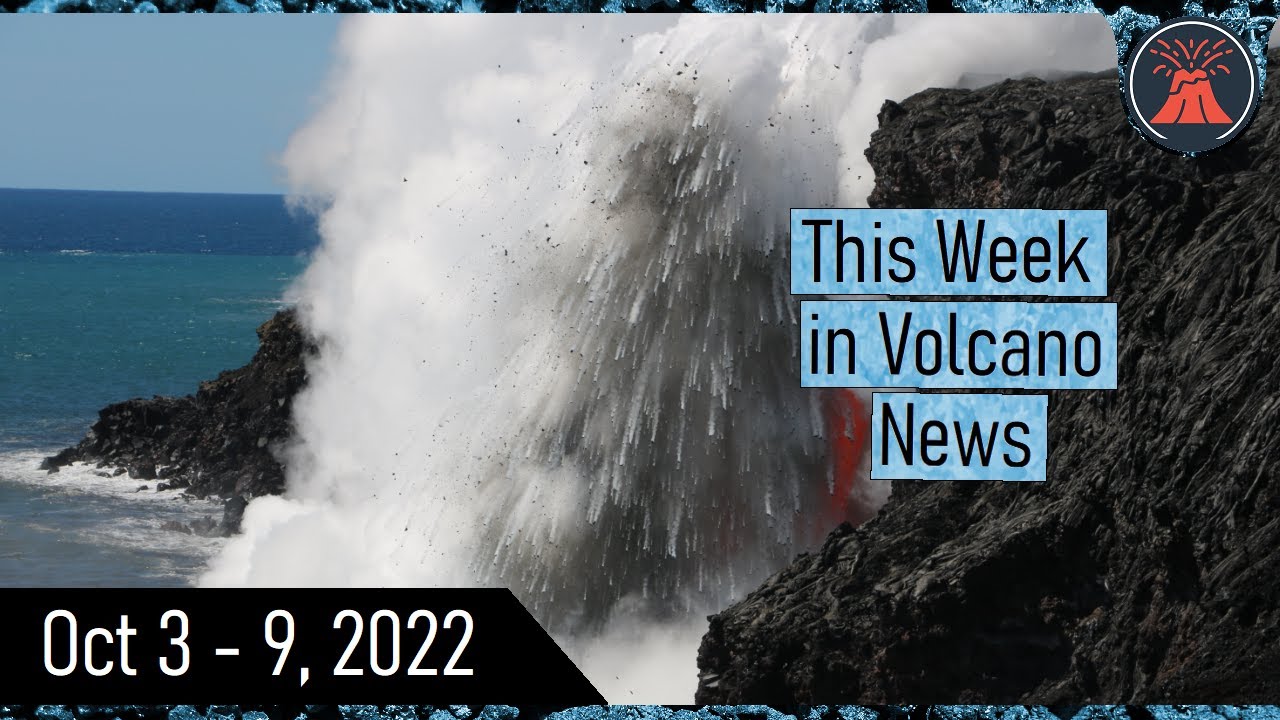
Thumbnail Photo Credit: U.S. Geological Survey, Hawaiian Volcano Observatory, Public Domain
If you would like to support this channel, consider becoming a patron at http://patreon.com/geologyhub.
Another way to support this channel is to make an order via our gemstone and geology related etsy store at http://prospectingarizona.etsy.com.
This channel’s merch store is also on etsy at http://geologyhub.etsy.com.
Graphics, tables, and images which contain eruption dates, lengths, and/or VEIs are sourced from (and sometimes courtesy of) the Global Volcanism Program, Smithsonian Institution (although sometimes with minor changes made by GeologyHub). https://volcano.si.edu/
Citation: Global Volcanism Program, 2013. Volcanoes of the World, v. 4.11.2 (02 Sep 2022). Venzke, E (ed.). Smithsonian Institution. Downloaded 7 Oct 2022. https://doi.org/10.5479/si.GVP.VOTW4-2013.
Source of Volcanic Explosivity Index (VEI) methodology and criteria: Newhall, C. G., and Self, S. (1982), The volcanic explosivity index (VEI) an estimate of explosive magnitude for historical volcanism, J. Geophys. Res., 87( C2), 1231– 1238, doi:10.1029/JC087iC02p01231. Accessed / Read on Oct 5 2022.
Google Earth imagery used in this video: ©Google & Data Providers
Key for volcano color codes shown in this video (this is only if they do not represent official alert levels from local government / volcanological agencies):
GREEN – Normal volcanic activity, very low chance of an eruption.
LIGHT YELLOW – Minor increase in levels of volcanic activity, such as increased earthquakes, very low chance of an eruption, but higher than with green.
BRIGHT YELLOW – Notable increase in levels of volcanic activity, potential changes at the volcano, increased risk of an eruption.
ORANGE – High volcanic unrest, this often means a volcano is about to erupt or has a greatly increased likelihood of erupting in the short to mid term future (seconds to weeks). However, an eruption occurring is not a certainty as this alert level.
RED – The volcano is erupting.
Creative Commons Licenses used for specific content (such as a single image within the video which as a whole does not entirely fall under the same license) or sections of specific content (such as a photo within a table) in this video (not the entire table for this example):
CC0 1.0: https://creativecommons.org/publicdomain/zero/1.0/legalcode
CC BY 2.0: https://creativecommons.org/licenses/by/2.0/legalcode
Sources:
0:00 Mount Erebus is Erupting
0:24 Erebus Crystals
0:44 This Week’s Top Stories
1:15 Mauna Loa Earthquake Swarm
2:50 Taal Eruption
3:46 Bulusan Earthquake Swarm
4:12 Full list of Erupting Volcanoes
4:29 Conclusion
Sources:
[1] Global Volcanism Program, 2019. Report on Mauna Loa (United States). In: Sennert, S K (ed.), Weekly Volcanic Activity Report, 26 June-2 July 2019. Smithsonian Institution and US Geological Survey.
[2] U.S. Geological Survey, Volcano Watch — Mauna Loa 1950 eruption: A lot of lava with little warning, https://www.usgs.gov/news/volcano-watch-mauna-loa-1950-eruption-lot-lava-little-warning
[3] National Parks Service, Mauna Loa, https://www.nps.gov/havo/learn/nature/mauna-loa.htm
[4] U.S. Geological Survey, Geology and History, https://www.usgs.gov/volcanoes/mauna-loa/geology-and-history#:~:text=Landslides%20have%20also%20occurred%20from,Loa%20emerged%20above%20sea%20level.
[5] U.S. Geological Survey, Frequently Asked Questions about Mauna Loa Volcano, https://www.usgs.gov/observatories/hawaiian-volcano-observatory/frequently-asked-questions-about-mauna-loa-volcano
[6] U.S. Geological Survey, Hawaiian Volcano Observatory
[7] Global Volcanism Program, 2004. Report on Mauna Loa (United States). In: Mayberry, G (ed.), Weekly Volcanic Activity Report, 8 September-14 September 2004. Smithsonian Institution and US Geological Survey.
[8] Phivolcs
[9] PVMBG
[10] US Geological Survey
[11] Alaskan Volcano Observatory
[12] Geonet
[13] Vanuatu Meteorology & Geo-Hazards Department
[14] INGV
[15] ESCUELA POLITÉCNICA NACIONAL INSTITUTO GEOFÍSICO
Creative Commons Image Sources:

https://www.flickr.com/photos/amanderson/44468364494


